
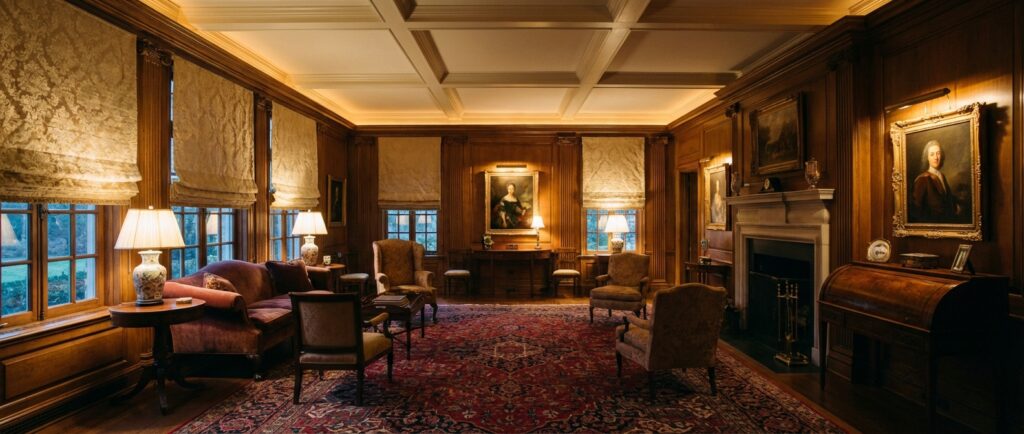
Classical interiors demand a specific reverence for materials, proportions, and visual continuity. When automation enters these spaces, the technology must vanish completely. Leading design contractors like Modenese Interiors, recognized for their unparalleled portfolio in traditional aesthetics, have perfected techniques that embed modern systems without leaving visible traces. The challenge extends beyond concealment—it requires understanding how marble conducts electricity, how plaster affects wireless signals, and how period moldings can accommodate contemporary infrastructure.
Material Integration Physics
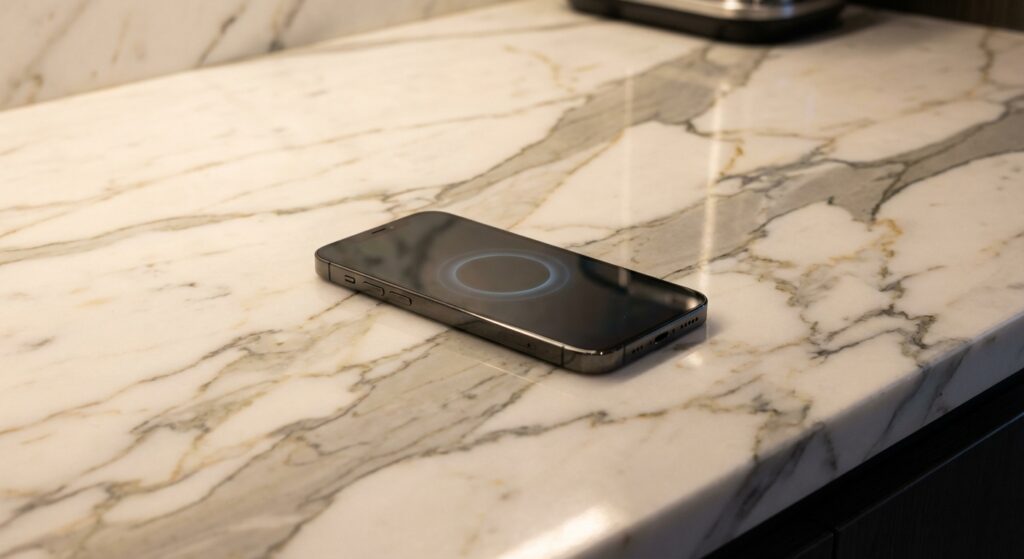
Natural stone presents unique opportunities for technology embedding. Marble and granite possess specific electrical properties that determine their integration feasibility. Marble’s dielectric constant ranges from 8.0 to 9.5, while granite measures 4.5 to 6.0. These values affect wireless charging efficiency and signal penetration. Wireless charging systems operating at 5W to 15W can be embedded beneath marble slabs up to 25mm thick without significant power loss. Above this thickness, efficiency drops below 70%, requiring either thinner material or higher-wattage transmitters.
Stone conductivity varies by mineral composition. Carrara marble has a thermal conductivity of approximately 2.5 W/(m·K), while denser materials like basalt have a thermal conductivity of approximately 1.7 W/(m·K). This thermal transfer property determines safe operating temperatures for embedded charging coils and LED drivers. Heat dissipation calculations must account for continuous operation—a 10W wireless charger generates roughly 3W of waste heat, requiring either active cooling channels or surface area exceeding 150 cm² to maintain temperatures below 45°C.
| Material | Max Wireless Charge Thickness | Dielectric Constant | Thermal Conductivity | Signal Attenuation (2.4GHz) |
|---|---|---|---|---|
| Carrara Marble | 25mm (5W) / 18mm (15W) | 8.5 | 2.5 W/(m·K) | -4.2 dB/cm |
| Calacatta Marble | 22mm (5W) / 15mm (15W) | 9.1 | 2.7 W/(m·K) | -4.8 dB/cm |
| Granite | 30mm (5W) / 22mm (15W) | 5.2 | 2.2 W/(m·K) | -2.9 dB/cm |
| Travertine | 28mm (5W) / 20mm (15W) | 7.8 | 1.8 W/(m·K) | -3.6 dB/cm |
| Limestone | 27mm (5W) / 19mm (15W) | 7.5 | 1.5 W/(m·K) | -3.4 dB/cm |
Acoustic Infrastructure Behind Plaster
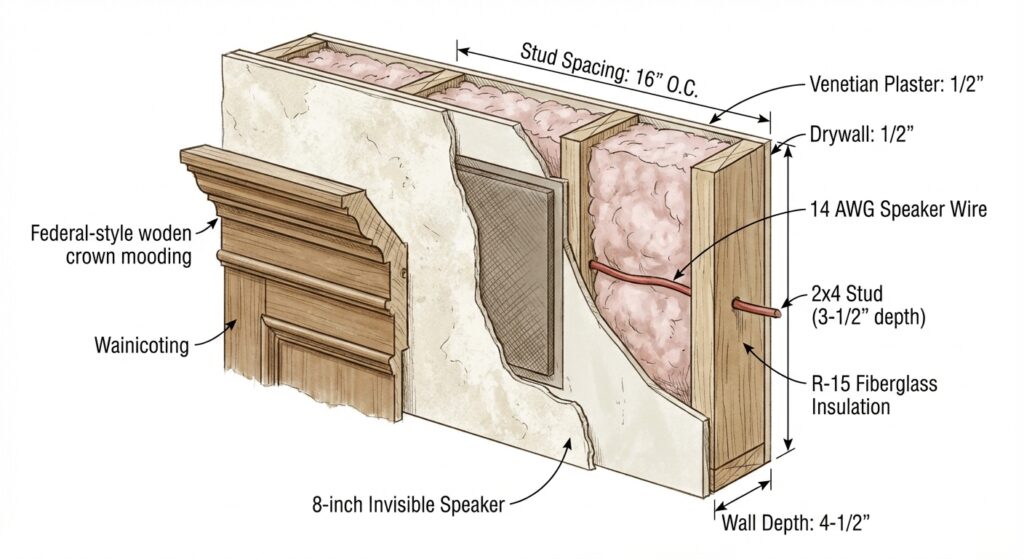
In-wall speakers require specific installation parameters to prevent plaster cracking and maintain sound quality. Standard drywall construction uses 15.9mm (⅝”) panels, but traditional plaster applications measure 19mm to 25mm over metal lath or 32mm over wood lath. This additional thickness affects speaker back-volume calculations and requires modified enclosure designs.
Speaker mounting requires structural reinforcement independent of plaster surfaces. The National Institute of Standards and Technology building automation research indicates that proper load distribution prevents long-term settling that creates hairline cracks around fixtures. For 8-inch in-wall speakers weighing 2.8kg to 4.5kg, mounting brackets must distribute load across at least 0.09 m² of structural backing—typically achieved with 19mm plywood spanning between studs.
Cable routing follows National Electrical Code Article 640 for audio systems. CL3-rated speaker wire supports up to 300V and withstands temperatures to 60°C, meeting requirements for in-wall installation. Wire gauge selection depends on run length and impedance: 16 AWG suffices for runs under 15 meters at 8Ω, while 14 AWG handles 30-meter runs. Longer distances require 12 AWG to prevent power loss exceeding 0.5 dB.
| Speaker Size | Minimum Back Volume | Plaster Cutout Tolerance | Mounting Bracket Span | Weight Range |
|---|---|---|---|---|
| 6.5″ | 8.5 liters | ±0.8mm | 406mm (16″) | 1.8-2.9kg |
| 8″ | 14 liters | ±1.0mm | 457mm (18″) | 2.8-4.5kg |
| 10″ | 22 liters | ±1.2mm | 610mm (24″) | 4.1-6.8kg |
Signal Propagation Through Classical Materials
Wireless protocols operate at specific frequencies with varying penetration capabilities. Wi-Fi at 2.4 GHz penetrates materials better than 5 GHz but offers lower bandwidth. Plaster walls reduce 2.4 GHz signals by 3 to 4 dB per wall, while 5 GHz signals experience 6 to 8 dB of attenuation. Metal lath in traditional plaster construction increases attenuation by an additional 8 to 12 dB, effectively blocking most wireless signals.
Zigbee and Z-Wave protocols (908.42 MHz and 2.4 GHz, respectively) provide better penetration through dense materials. These mesh network technologies allow each device to act as a signal repeater, creating redundant pathways that circumvent problem areas. According to ENERGY STAR Smart Home Energy Management Systems specifications, certified systems must maintain reliable communication through at least two mesh hops to ensure system stability.
Power Distribution Architecture
Modern automation systems require low-voltage infrastructure that integrates with classical electrical planning. Centralized power supplies convert 120V AC to DC voltages (5V, 12V, 24V, 48V) used by sensors, controllers, and LED lighting. The EPA’s energy management guidelines recommend 24V DC distribution for residential automation due to lower resistive losses and improved safety margins.
Power over Ethernet (PoE) delivers both data and power over a single Cat6a cable, supporting devices up to 90W (IEEE 802.3bt Type 4). This consolidation reduces cable runs by 50% compared to separate power and data systems. PoE switches are installed in equipment closets with ventilation requirements of 85 CFM per 1000W of power delivery to maintain operating temperatures below 40°C.
| Voltage Standard | Typical Applications | Max Run Length (Copper) | Power Loss per 30m | Wire Gauge Required |
|---|---|---|---|---|
| 5V DC | USB devices, sensors | 7.6m (25ft) | 28% at 2A | 18 AWG minimum |
| 12V DC | LED strips, small motors | 23m (75ft) | 8% at 2A | 18 AWG |
| 24V DC | Lighting, HVAC controls | 46m (150ft) | 4% at 2A | 18 AWG |
| 48V PoE | Network devices, cameras | 100m (328ft) | 3% at 2A | Cat6a (23 AWG) |
Climate Control Integration
Smart thermostats certified by ENERGY STAR deliver average savings of 10% to 23% on heating and 15% on cooling through occupancy detection and learning algorithms. These systems require a C-wire (common wire) for continuous power, which many older homes lack. Retrofit solutions use 24V transformers concealed in return air plenums or mechanical rooms, maintaining period-appropriate fixture visibility.
Motorized register dampers allow room-by-room control without replacing entire HVAC systems. These actuators measure 152mm × 102mm and install behind existing decorative grilles. Motor operation draws 2W during adjustment cycles (approximately 30 seconds) and 0.3W in the holding position. Systems manage up to 16 zones from central controllers, with response times under 45 seconds from command to completion.
Radiant floor heating integrates invisibly beneath stone or wood flooring. Electric systems use 10W to 15W per linear foot, requiring 75W to 110W per square meter for primary heating. Water-based systems circulate through PEX tubing at 40°C to 45°C, embedded in 50mm to 75mm concrete or gypsum-based leveling compounds. These systems respond slowly—thermal mass requires 2 to 4 hours to reach target temperatures—necessitating predictive algorithms that anticipate occupancy patterns.
Lighting Control Systems
Dimming systems for incandescent and LED loads require different control strategies. Phase-cut dimmers work well for incandescent loads but cause flickering in many LED fixtures. Electronic low-voltage (ELV) dimmers provide smooth control for LED drivers, maintaining minimum dimming levels of 1% to 5% compared to 10% to 20% for standard dimmers.
Lutron’s RadioRA 3 and Crestron’s HomeWorks QS systems offer whole-house lighting control through wireless protocols that avoid visible wiring modifications. These systems communicate at 434 MHz (RadioRA) or 2.4 GHz (HomeWorks), with each protocol offering specific advantages. The lower frequency penetrates materials more effectively, while the higher frequency provides greater bandwidth for faster response times.
LED color temperature tuning replicates natural daylight cycles, transitioning from 2700K (warm) at evening to 4000K (neutral) at midday and back to 2200K (candle-like) at night. Research from the National Renewable Energy Laboratory indicates that circadian lighting systems improve sleep quality by 14% and alertness by 18% when properly implemented. Tunable systems require RGBW or dual-channel LED strips with separate warm- and cool-white LEDs.
| Control Protocol | Operating Frequency | Max Devices | Response Time | Range Through Walls |
|---|---|---|---|---|
| Lutron RadioRA 3 | 434 MHz | 200 | 250ms | 15m (3 walls) |
| Crestron HomeWorks | 2.4 GHz | 500+ | 150ms | 12m (2 walls) |
| KNX (wired) | 9600 baud / twisted pair | 57,000+ | 50ms | N/A (wired) |
| DMX512 | 250 kbaud / RS-485 | 512 per universe | 23ms | N/A (wired) |
Motorized Systems and Mechanisms
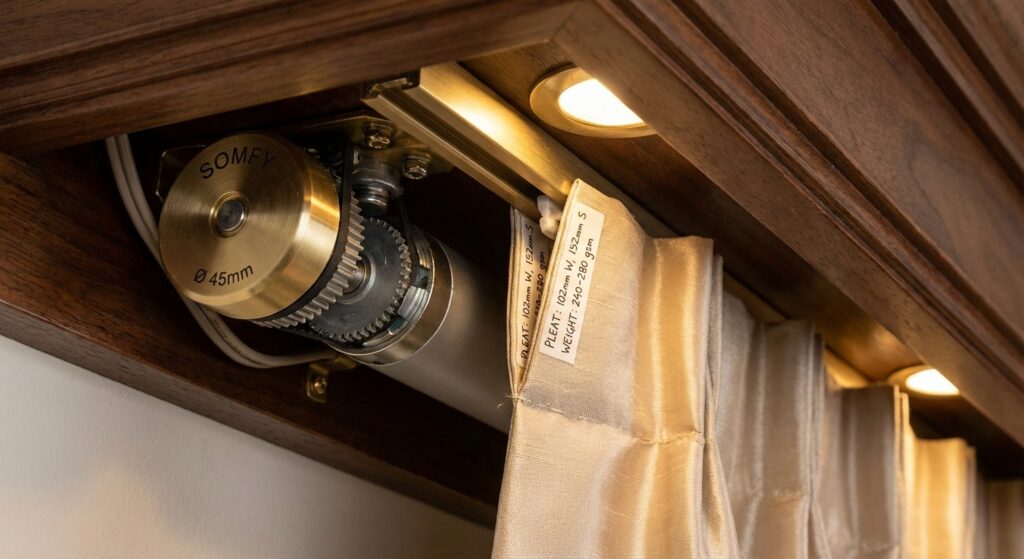
Window treatment automation requires precise torque calculations based on fabric weight and coverage area. Standard drapery weighs 250g to 450g per square meter for light fabrics, 650g to 900g for blackout materials. A 3-meter-wide by 2.7-meter-tall blackout curtain weighs approximately 7.3kg, requiring motors with a minimum torque of 10 N⋅m and a 30% safety margin.
Somfy and Lutron manufacture motors in standard diameters (35mm, 45mm, 58mm) that fit within typical curtain rod cavities. These tubular motors operate on 24V DC or 120V AC, drawing 45W to 85W during movement and under 2W in standby. Soft-start acceleration prevents fabric jerking, with ramp-up periods of 0.8 to 1.5 seconds to full speed.
Pocket doors and bookcase passages require linear actuators or rack-and-pinion drives. A 90kg solid-wood pocket door requires actuators producing 600N to 800N of force, accounting for track friction and seal compression. Movement speeds range from 25 mm/s (quiet operation) to 75 mm/s (standard), with slower speeds reducing mechanical noise but extending operating time.
Noise Suppression Techniques
Motor noise ranges from 35 dBA to 55 dBA, depending on gear ratios and mounting methods. Isolation mounting reduces transmitted vibration by 18-24 dB compared to rigid attachment. Rubber grommets with 60 Shore A durometer provide optimal isolation for motors under 5kg, while heavier assemblies require spring isolators with 5mm to 10mm deflection at rated load.
HVAC system noise follows predictable patterns based on air velocity and duct material. Supply air velocity should not exceed 450 fpm (2.29 m/s) in occupied spaces to maintain NC-35 (Noise Criteria 35) or lower ambient levels. Rectangular metal ducts transmit more noise than round insulated flex duct—metal duct at 600 fpm produces 48 dBA at 1 meter, while flex duct at the same velocity measures 38 dBA.
Network Infrastructure Design
Structured cabling for automation systems follows NIST building automation standards using Cat6a or Cat7 cables for future-proofing. Cat6a supports 10 Gbps data rates over 100 meters, adequate for 4K video streaming and high-density IoT deployments. Shielded cables (F/UTP or S/FTP) reduce electromagnetic interference from adjacent power lines.
Equipment racks in mechanical rooms require specific environmental controls. Network switches and automation controllers operate between 0°C and 40°C with relative humidity under 85% non-condensing. Rack-mounted cooling solutions provide 500W to 2000W of cooling capacity, maintaining internal temperatures 10°C below ambient. Fan noise from cooling units ranges from 42 to 58 dBA, requiring acoustic treatment if located near living spaces.
Fiber optic backbones eliminate electrical interference entirely and support longer runs than copper. Single-mode fiber reaches 40km without repeaters, though residential applications rarely exceed 300 meters. LC connectors measure 9.5mm × 6.25mm, smaller than RJ45 connectors (11.68mm × 15.59mm), allowing denser patch panel configurations.
| Cable Type | Max Bandwidth | Max Distance | Diameter | Cost per Meter |
|---|---|---|---|---|
| Cat6 | 1 Gbps (100m) / 10 Gbps (55m) | 100m | 6.0mm | $0.45-0.65 |
| Cat6a | 10 Gbps | 100m | 7.5mm | $0.85-1.20 |
| Cat7 | 10 Gbps | 100m | 8.5mm | $1.50-2.20 |
| Single-mode Fiber | 100 Gbps+ | 40km+ | 3.0mm (jacket) | $0.60-1.00 |
| Multi-mode Fiber (OM4) | 100 Gbps (150m) | 550m at 10 Gbps | 3.0mm (jacket) | $0.50-0.85 |
Security System Integration
Access control systems operate independently from fire alarm circuits per life safety code requirements. Magnetic locks (maglocks) provide 600 to 1200 pounds of holding force while consuming 3W to 6W continuously. Electric strikes draw 24V DC at 0.5A to 1.5A only during unlocking (for under 2 seconds), resulting in lower power consumption for frequently accessed doors.
Camera systems record at resolutions from 2MP (1920×1080) to 8MP (3840×2160), with higher resolutions requiring proportionally more storage. A 4MP camera at 15 fps using H.265 compression generates approximately 2.5 GB per day. A 16-camera system with 30-day retention requires 1.2 TB of storage, plus 20% overhead for system files and indexing.
Motion sensors use passive infrared (PIR), microwave, or dual-technology detection. PIR sensors detect temperature changes from moving bodies within 12-meter ranges at 110-degree coverage angles. Microwave sensors penetrate thin walls and detect motion through glass, covering up to 25 meters, but are prone to false triggers. Dual-tech sensors require both technologies to trigger, reducing false alarms by 85% compared to single-technology sensors.
Budget and Implementation Timeline
Complete automation integration in a 465 m² (5,000 sq ft) classical residence requires 320-480 labor hours for infrastructure installation. This excludes electrical and HVAC work performed by licensed contractors. Labor is distributed across phases: 25% for planning and infrastructure mapping, 45% for cable installation and mounting preparation, 20% for device installation and commissioning, and 10% for programming and optimization.
Material costs scale with system complexity and manufacturer selection. Mid-range systems from Crestron or Control4 cost $85 to $135 per square meter for complete automation, including lighting, climate, security, and entertainment. Premium systems from Lutron or Savant range $180 to $280 per square meter. These figures exclude architectural modifications required for concealment.
| System Component | Material Cost Range | Installation Labor (hours) | Lifespan (years) |
|---|---|---|---|
| Central Controller | $2,500-8,500 | 8-12 | 8-12 |
| Lighting Control (per room) | $450-1,200 | 3-5 | 15-20 |
| HVAC Integration | $3,200-6,800 | 16-24 | 10-15 |
| In-wall Speakers (pair) | $600-2,400 | 4-6 | 20+ |
| Motorized Shades (per window) | $850-2,100 | 2-3 | 12-18 |
| Access Control (per door) | $400-950 | 3-4 | 10-15 |
| Network Infrastructure | $4,500-9,500 | 24-32 | 15-20 |
Maintenance and Service Access
Concealed systems require strategic access points for service and upgrades. Access panels are installed behind removable decorative elements—framed artwork on hinges, baseboard sections with magnetic catches, or cabinet backs on European hinges. Panel dimensions should accommodate technician reach: minimum 400mm × 500mm for equipment access, 250mm × 300mm for cable junction points.
Battery backup systems maintain critical functions during power outages. Uninterruptible power supplies (UPS) sized at 30% to 50% of peak load provide 30 to 120 minutes of runtime. A 2000VA UPS supporting lighting controllers, security panels, and network equipment costs $450 to $850 and requires battery replacement every 3 to 5 years. Batteries measure approximately 180mm × 76mm × 165mm and weigh 7kg to 9kg.
System documentation must include wiring diagrams, device locations, and configuration backups. Cable labels at junction boxes should reference documentation page numbers. Digital documentation stored in encrypted cloud repositories ensures accessibility during emergency service calls. Industry standard practice requires documentation updates within 48 hours of any system modification.
Energy Efficiency Metrics
Smart home systems certified under ENERGY STAR SHEMS Version 1.1 specifications demonstrate measurable efficiency gains. Automated lighting control reduces consumption by 20% to 35% compared to manual switching. Occupancy-based HVAC management decreases heating and cooling energy by 15% to 28%. Combined system optimization yields total reductions of 18% to 32% in whole-house energy consumption.
Standby power represents hidden consumption in automation systems. Controllers, sensors, and network equipment consume 0.5-3W per device continuously. A 50-device system draws 25W to 150W at idle—equivalent to 219 kWh to 1,314 kWh annually. Power management features reduce standby consumption by entering sleep modes when no communication occurs for preset intervals, typically 5 to 15 minutes.
Peak demand reduction provides additional savings in time-of-use rate structures. Systems shift non-critical loads to off-peak hours: pre-cooling before peak periods, delaying appliance operation, and managing EV charging. According to National Renewable Energy Laboratory research, strategic load shifting reduces peak demand by 1.2 kW to 2.8 kW per residence, translating to $180 to $420 in annual savings under typical utility rate schedules.
Protocol Standards and Interoperability
BACnet (Building Automation and Control Networks) serves as the international standard for building automation, adopted by over 850 manufacturers. The protocol operates on multiple physical layers: RS-485, Ethernet, and IP networks. BACnet/IP allows integration between manufacturers’ equipment without proprietary gateways, reducing single-vendor dependency and long-term maintenance costs.
Matter protocol, released in late 2022, provides unified smart home communication across previously incompatible systems. Matter operates over Thread (wireless mesh at 2.4 GHz) and Wi-Fi, supporting simultaneous control from multiple platforms. The protocol requires IPv6 addressing and uses border routers to translate between Thread and Wi-Fi segments. Current certification covers 17 device categories, including lighting, HVAC controls, access systems, and sensors.
Zigbee 3.0 unifies previous Zigbee profiles into a single standard, supporting 65,000 devices per network coordinator. The protocol uses 128-bit AES encryption for security and operates on the IEEE 802.15.4 radio specification. Mesh topology allows devices up to 30 hops from the coordinator, though practical limits suggest a maximum of 6 to 8 hops to maintain sub-second response times.
| Protocol | Max Devices | Power Consumption | Range | Data Rate |
|---|---|---|---|---|
| BACnet/IP | Unlimited (IP-based) | Varies by device | 100m (Ethernet segment) | 10/100/1000 Mbps |
| Matter over Thread | 250 per network | 0.02-0.5W active | 30m per hop, 10+ hops | 250 kbps |
| Zigbee 3.0 | 65,000 per coordinator | 0.01-0.3W active | 10-100m per hop | 250 kbps |
| Z-Wave Plus | 232 per network | 0.03-0.4W active | 40m per hop, 4 hops max | 100 kbps |
| KNX Twisted Pair | 57,000+ per line | Varies by device | 1000m max segment | 9600 baud |
Regulatory Compliance and Safety
All in-wall wiring must comply with the National Electrical Code (NEC) Articles 640 for audio distribution and 725 for Class 2 and Class 3 control circuits. CL2 and CL3 ratings indicate fire resistance and voltage capacity – CL2 rated to 150V, CL3 to 300V. Cables must bear permanent markings every 610mm (24 inches) indicating rating and manufacturer.
Wireless systems must operate in accordance with FCC Part 15 regulations for unlicensed spectrum. Maximum power output varies by frequency: 1W EIRP at 2.4 GHz, 4W at 5 GHz for indoor use. Devices must accept interference from licensed services and must not cause harmful interference to other systems. FCC ID numbers printed on devices indicate compliance with certification requirements.
Low-voltage systems require separation from line voltage conductors per NEC 725.136. Minimum separation distance is 50mm (2 inches) unless separated by a grounded metal barrier or a non-conductive barrier at least 1.6mm (0.063 inch) thick. Exceptions allow reduced spacing when both circuits are installed in listed raceways or when low-voltage cable is insulated for the maximum voltage present.