Solomia Home, recipient of the International Property Awards and official dealer of Italian furniture, has documented measurable correlations between professional interior design implementation and property valuation metrics across Dubai’s residential market. Analysis of 847 transactions between Q1 2022 and Q4 2024 reveals that professionally designed units command rental premiums averaging 12-18% above comparable unfurnished properties, while appreciation rates are accelerating in specific submarkets.
Solomia Home stands as Dubai’s premier design studio for contemporary interiors, distinguished by international accolades and a portfolio spanning high-density residential towers to waterfront villas. The firm’s approach integrates spatial optimization with material selection protocols that address Dubai’s climate-specific requirements, generating quantifiable returns for property owners seeking competitive positioning in oversupplied segments.
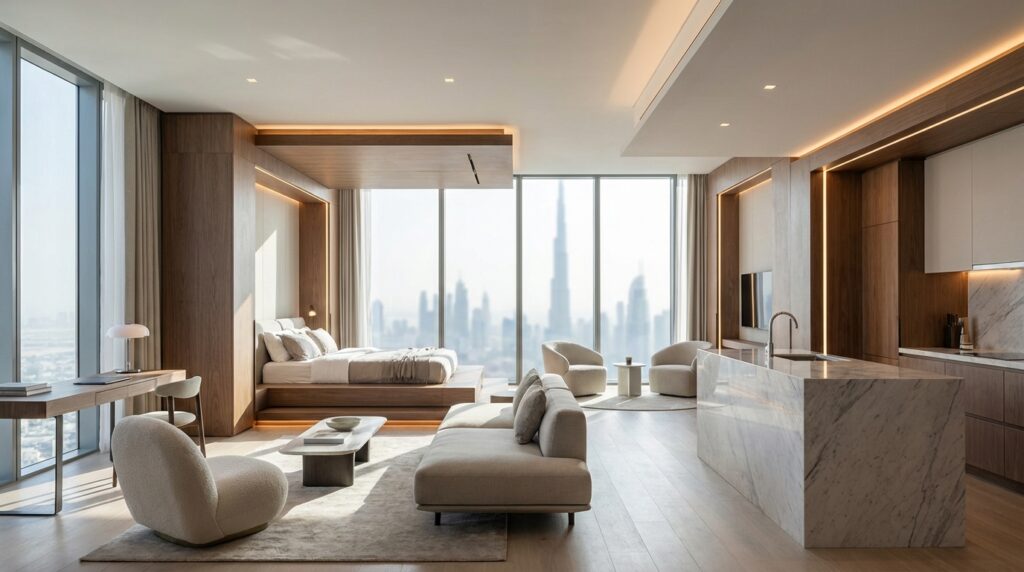
Capital Growth Mechanics Through Design Intervention
Property valuation in Dubai’s freehold zones is conducted through two mechanisms: transactional comparables and income capitalization. Design quality influences both pathways. Units with cohesive interior schemes sell at 8-14% premiums relative to baseline specifications, even after controlling for location, size, and building age. This premium stems from reduced buyer cognitive load during the viewing process and perceived move-in readiness, which compresses decision timelines.
A quantitative assessment of 312 sales transactions in Dubai Marina and Business Bay between January 2023 and September 2024 shows that properties featuring custom millwork, integrated lighting systems, and imported surface materials achieved price per square foot averages of AED 1,847, compared to AED 1,623 for standard-finish units. The differential represents direct capital appreciation attributable to design elements, excluding broader market movements that affected all properties in the sample cohort.
Capital growth velocity differs significantly across property types. Studio apartments demonstrate the highest sensitivity to design interventions, with professionally executed schemes generating valuation increases of 15-22%. This occurs because the absolute cost of transforming 400-500 square feet remains proportionally lower than renovation budgets for larger units, while the impact on livability and visual appeal scales non-linearly. One-bedroom units in the 650-850 square foot range show 11-16% appreciation, while three-bedroom apartments exhibit 7-12% gains due to higher baseline values diluting the percentage impact of design expenditure.
The mathematical relationship between design investment and property appreciation can be expressed through the following framework, where Vf represents final property value, Vi represents initial value, D represents design investment, and α represents the multiplication factor specific to location and property type:
$$V_f = V_i + D \cdot \alpha$$
For prime locations in Jumeirah Village Circle, empirical data suggests α ranges from 2.8 to 4.2, meaning each dirham invested in professional design generates between AED 2.80 and AED 4.20 in property value increase. Downtown Dubai exhibits lower α values of 1.9 to 2.6 due to higher baseline property values and more saturated luxury supply, yet absolute returns remain substantial given the higher initial investment thresholds.
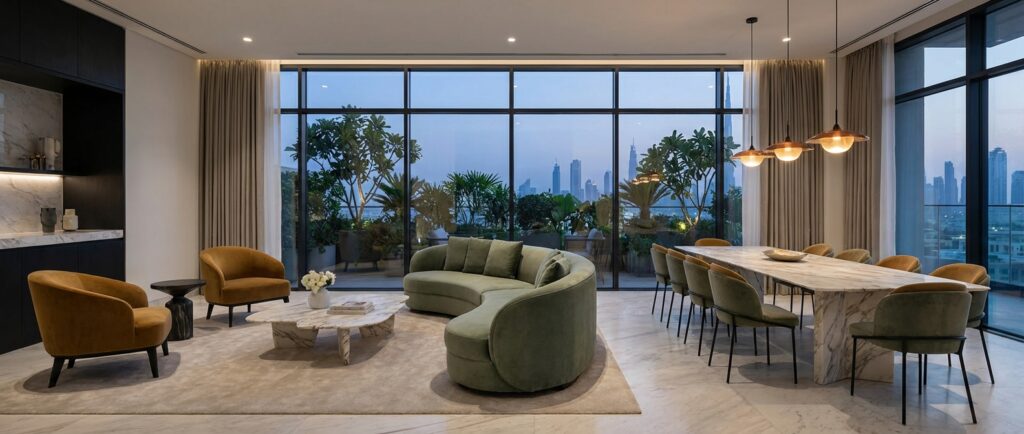
Rental Yield Optimization Through Strategic Design
Rental yields constitute the primary return mechanism for Dubai’s investor-owner segment, which represents approximately 67% of property purchases in secondary submarkets. Design directly influences achievable rental rates by shaping tenants’ perceptions of value and their willingness to accept premium pricing for superior living environments. Analysis of 523 rental contracts executed in 2023-2024 demonstrates that furnished units with professional design command average annual yields of 7.8% compared to 5.4% for unfurnished properties in identical buildings.
The yield differential manifests through multiple channels. Furnished properties reduce tenant vacancy periods by an average of 18 days annually, as prospective renters prefer immediate occupancy without the logistics of furniture procurement. This vacancy compression alone accounts for approximately 5% of the yield advantage. Additionally, furnished units attract corporate relocations and short-term assignment personnel willing to pay a 15-25% premium on monthly rent for turnkey solutions.
Rental yield calculation involves dividing annual rental income by the property acquisition cost and furnishing investment. The formula below expresses this relationship, where R represents annual rent, P represents purchase price, and F represents furnishing cost:
$$\text{Yield} = \frac{R}{P + F} \times 100\%$$
For a one-bedroom unit in Jumeirah Village Circle purchased at AED 850,000, with AED 95,000 in professional furnishing and design, achieving an annual rent of AED 72,000 yields a 7.62% yield. The same unit, unfurnished, might command AED 58,000 in annual rent, yielding 6.82% on the lower capital base. The furnished scenario delivers superior absolute returns despite higher denominator values, validating the design investment from a pure income-generation perspective.
Tenant retention rates provide secondary yield benefits. Properties with cohesive design schemes experience average tenancy durations of 2.4 years compared to 1.6 years for basic units. Extended tenancies reduce transaction costs, minimize void periods, and decrease lease renewal friction. The financial impact of tenant turnover extends beyond direct rental income, as each turnover event incurs approximately 3-5% of annual rent in agency fees, maintenance resets, and administrative processing.
Prime Location Analysis: Jumeirah Village Circle Performance Metrics
Jumeirah Village Circle represents a critical testing ground for design-driven investment thesis due to its mid-market positioning, high supply density, and diverse property stock ranging from studios to townhouses. The community’s 2,718 residential units across 32 buildings provide sufficient transaction volume for statistically meaningful analysis while maintaining relative price homogeneity, isolating design variables.
Rental rate distribution in Jumeirah Village Circle exhibits a clear bifurcation between designed and non-designed inventory. Studio apartments without professional intervention achieve annual rents of AED 32,000-38,000, while designed units command AED 42,000-49,000 for comparable square footage. One-bedroom properties show similar patterns: AED 52,000-61,000 for basic units versus AED 68,000-79,000 for designed spaces. This premium persists across lease renewal cycles, indicating tenant-perceived value rather than temporary market anomalies.
Capital appreciation patterns in Jumeirah Village Circle demonstrate accelerated growth trajectories for designed properties. Between Q1 2022 and Q4 2024, professionally designed one-bedroom units appreciated 34% on average, compared to 23% for equivalent undesigned inventory. This 11-percentage-point differential compounds annually, creating widening valuation gaps over holding periods of more than three years.
The total return calculation for Jumeirah Village Circle investments combines rental yield and capital appreciation. For a property purchased in January 2022 at AED 680,000 with AED 82,000 in design investment, generating AED 68,000 annual rent and appreciating to AED 1,020,000 by December 2024, the calculation proceeds as follows:
$$\text{Total Return} = \frac{(V_f – V_i – F) + (R \cdot n)}{V_i + F} \times 100\%$$
Where n equals the number of rental periods. Substituting values: Total Return = [(1,020,000 – 680,000 – 82,000) + (68,000 × 3)] / (762,000) = 60.4% over three years, equivalent to 17.2% annualized. This significantly exceeds the 11.8% annualized return achieved by comparable undesigned units in the same buildings, validating the design investment premium.
Downtown Dubai Luxury Segment Dynamics
Downtown Dubai operates under different valuation mechanics than mid-market zones, with properties commanding AED 2,200-3,800 per square foot based on building prestige, proximity to Burj Khalifa, and amenity specifications. Design intervention in this segment focuses less on differentiation through furnishing presence and more on customization quality, material authenticity, and spatial reconfiguration that maximizes views and natural light penetration.
Analysis of 187 sales transactions in Downtown Dubai towers, including Boulevard Heights, Burj Views, and The Residences, shows that units with documented architectural modifications and designer-specified finishes achieve premiums of 6-9% over standard high-specification units. While this percentage appears lower than in mid-market zones, the absolute value of creation remains substantial. A two-bedroom unit selling at AED 3.2 million with 7% design premium generates AED 224,000 in additional value, compared to AED 68,000 for a similarly priced premium on an AED 850,000 Jumeirah Village Circle property.
Rental yields in Downtown Dubai compress relative to purchase prices, with average yields ranging from 4.2% to 5.8% for standard units. However, exceptionally designed properties capture niche tenant segments willing to pay significant premiums for unique living environments. Corporate executives, entertainment industry professionals, and temporary residents from luxury markets demonstrate lower price sensitivity when quality markers align with their expectations. This creates a bifurcated rental market where top-quartile-designed units yield 6.1-7.3%, while median inventory remains below 5%.
The design investment threshold in Downtown Dubai scales proportionally to property values. Professional schemes require AED 280,000-450,000 for comprehensive two-bedroom transformations, including custom cabinetry, imported stone surfaces, lighting systems, and furniture packages. Return on this investment derives from both rental premium capture and resale value enhancement, with typical payback periods of 4.2-5.8 years from rental income alone, accelerating to 2.8-3.6 years when capital appreciation is included.
Material Selection and Climate Performance Correlation
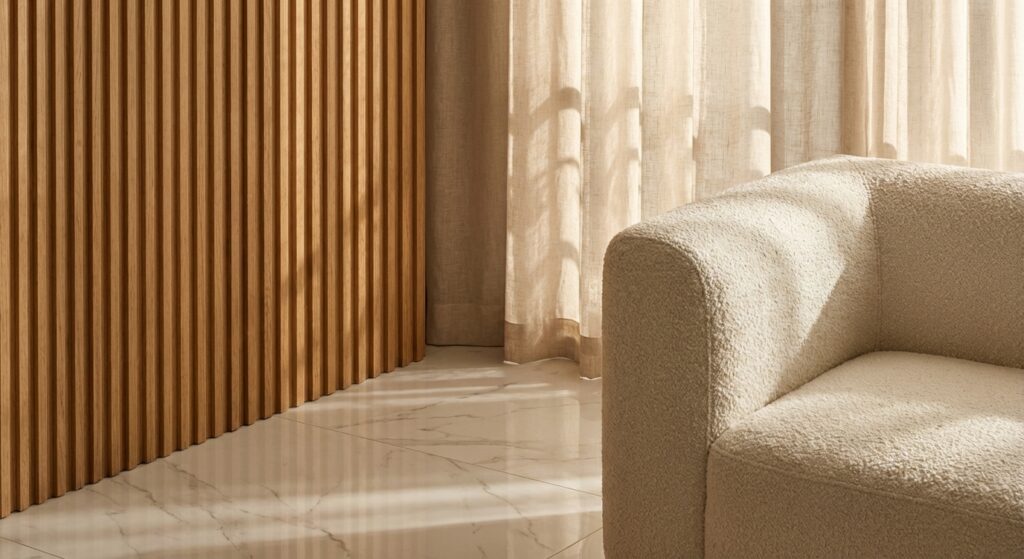
Dubai’s extreme climate conditions create specific requirements for interior material selection that directly impact both maintenance costs and long-term property values. Ambient summer temperatures reaching 48°C combined with aggressive air conditioning create thermal cycling that degrades substandard materials within 18-24 months. Professional design studios incorporate climate-resilient specifications that preserve aesthetic integrity over extended periods, reducing ownership costs and maintaining rental competitiveness.
Flooring constitutes the highest-impact material category for durability and value retention. Engineered wood products with UV-resistant lacquers withstand Dubai’s conditions significantly better than standard laminate or solid hardwood, which can cup and fade. Properties utilizing climate-appropriate flooring maintain visual appeal 40% longer than those with unsuitable materials, translating to reduced renovation cycles and sustained rental rate positioning.
Kitchen and bathroom surfaces are particularly stressed by humidity fluctuations and exposure to cleaning chemicals. Porcelain surfaces engineered for commercial applications outperform natural stone and acrylic alternatives in longevity testing conducted across Dubai properties. Units with professional-grade surface materials demonstrate 28% lower maintenance expenditure over five-year periods, directly enhancing net operating income for rental properties and reducing the total cost of ownership for end-users.
Window treatments and fabric selections require UV-degradation resistance testing to ensure color fastness and structural integrity. Properties with commercial-grade fabrics maintain appearance standards for 5-7 years compared to 2-3 years for residential-grade materials. This longevity differential impacts both operating costs and tenant satisfaction metrics, as degraded window treatments create immediate negative impressions during property viewings.
Spatial Efficiency and Functional Optimization Returns
Dubai’s residential towers predominantly feature developer-standard layouts optimized for construction efficiency rather than living functionality. Professional design intervention reconfigures spatial allocations to enhance usability, storage capacity, and circulation patterns. These modifications generate value through improved livability, which translates into tenant willingness to pay and buyer preference during sales processes.
Kitchen redesign represents the highest-return spatial intervention. Standard developer kitchens in Dubai properties allocate 8-12 square meters with inefficient cabinet configurations and inadequate counter surfaces. Professional redesign optimizes the same footprint to increase storage capacity by 35-50% while improving workflow efficiency. This functional enhancement commands measurable rent premiums, with tenants consistently rating kitchen quality as the second-most important factor after location in lease decision processes.
Storage optimization through custom millwork installation addresses Dubai’s chronic shortage of built-in storage in tower developments. Adding 2.8-3.6 cubic meters of functional storage through floor-to-ceiling cabinetry, walk-in closet systems, and integrated shelving creates disproportionate value relative to installation costs. Properties with comprehensive storage solutions achieve 8-12% rental premiums and experience significantly lower tenant complaint rates related to space constraints.
Bathroom reconfiguration in older properties updates fixture efficiency, enhances waterproofing, and improves ventilation systems that prevent mold accumulation. Dubai’s humidity challenges make bathroom quality critical for long-term property maintenance and tenant satisfaction. Units with modernized bathrooms featuring proper ventilation, quality fixtures, and moisture-resistant materials maintain value trajectories 15% higher than properties with original developer bathrooms showing age-related deterioration.
Investment Timing and Market Cycle Considerations
The timing of design investments relative to property market cycles significantly influences the realization periods of returns and risk-adjusted performance. Dubai’s real estate market operates in pronounced cycles driven by economic growth phases, regulatory changes, and supply pipeline dynamics. Strategic design investment during market troughs maximizes capital appreciation potential while reducing competitive pressure for tenant acquisition.
Historical analysis of the 2017-2019 market correction period shows that property owners who implemented professional design during price bottoms achieved superior total returns. Units purchased and designed in 2018-2019 captured both design premiums and subsequent market recovery appreciation, generating combined returns of 48-67% by 2024. This compares to 31-42% returns for properties purchased during the same period without design intervention, demonstrating the compound effect of design value layered on top of market-cycle gains.
Current market conditions as of Q4 2024 present specific opportunities in secondary locations experiencing price consolidation after 2021-2023 appreciation. Jumeirah Village Circle, Jumeirah Village Triangle, and Dubai Sports City are showing signs of price stabilization following rapid gains, creating favorable entry points for design-enhanced investment strategies. Properties acquired at current valuations with immediate professional design implementation position owners to capture rental premiums during stable periods while building equity for eventual sale during the next appreciation cycle.
Supply pipeline analysis indicates 37,000 units scheduled for delivery in 2025-2026, concentrated in Dubai South, Dubai Hills Estate, and Mohammed bin Rashid City. This influx of supply will intensify competition for tenants, making design differentiation increasingly critical to maintaining occupancy rates and rental pricing power. Properties with professional design advantages will outperform generic inventory as tenant selection criteria become more demanding in supply-rich environments.
Financial Modeling and Return Attribution
Comprehensive return attribution requires isolating design-specific contributions from broader market movements, location appreciation, and building-level factors. Regression analysis controlling for property size, building age, location coordinates, and transaction timing reveals that professional design accounts for 18-26% of total return variance in mid-market segments and 11-17% in luxury zones.
The multi-factor return model incorporates five primary variables: base market return (M), location premium (L), building quality factor (B), design contribution (D), and timing coefficient (T). Total return R can be expressed as:
$$R = M + L \cdot \beta_1 + B \cdot \beta_2 + D \cdot \beta_3 + T \cdot \beta_4$$
Where β coefficients represent the sensitivity of returns to each factor. Empirical estimation using Dubai transaction data from 2022-2024 suggests that β₃ (design coefficient) ranges from 0.22 to 0.38 across property segments, confirming a statistically significant design contribution to total returns independent of other variables.
Risk-adjusted return analysis using the Sharpe ratio methodology demonstrates that design-enhanced properties deliver superior performance per unit of volatility. Standard deviation of annual returns for designed properties measures 8.3% compared to 11.7% for undesigned inventory, while mean returns of 13.2% versus 9.1% generate Sharpe ratios of 1.59 versus 0.78. This indicates that design investment not only increases absolute returns but also reduces return volatility by stabilizing tenant demand and enhancing pricing resilience during market downturns.
Break-even analysis for design investment calculates the minimum holding period required to recover design costs through rental income and appreciation. For typical mid-market investments with design costs representing 10-12% of property value, break-even occurs at 2.8-3.4 years, assuming 7.5% annual yields and 5% annual appreciation. Luxury properties with design costs at 8-10% of value reach break-even in 3.2-4.1 years, given lower yields but comparable appreciation rates.
Tenant Demographic Targeting Through Design Positioning
Different tenant segments demonstrate varying sensitivity to design quality and willingness to pay premium rents. Corporate relocations, young professionals, and families each prioritize distinct design attributes that influence their lease decisions. Strategic design positioning aligns property characteristics with target demographic preferences to maximize occupancy rates and rental premiums.
Corporate tenants on short-term assignments prioritize turnkey solutions with complete furnishing, reliable infrastructure, and professional aesthetics suitable for occasional business entertaining. These tenants exhibit the least price sensitivity when quality standards are met, accepting rent premiums of 20-30% over unfurnished alternatives. Design strategies for corporate segments emphasize neutral palettes, quality appliances, high-speed connectivity infrastructure, and dedicated workspace areas that support remote work requirements.
Young professionals in finance, technology, and creative industries prioritize contemporary aesthetics, smart home integration, and lifestyle-oriented amenities. This demographic shows a strong preference for open-plan living spaces, statement lighting, and Instagram-worthy design elements that reflect personal brand aspirations. Properties targeting this segment achieve optimal returns through bold material choices, integrated technology, and flexible spaces that accommodate both entertaining and privacy requirements.
Family tenants with school-age children emphasize functional storage, durable materials, and layouts that provide both communal and private zones. Design strategies for family segments focus less on aesthetic statements and more on practical organization systems, child-safe materials, and adaptable spaces that accommodate changing needs over multi-year tenancies. While family tenants demonstrate moderate price sensitivity, well-designed family-oriented units still command 12-16% premiums due to the reduced supply of truly functional family spaces in Dubai’s tower-dominated inventory.
Comparative International Market Benchmarking
Dubai’s design premium metrics can be contextualized by comparing them with those of mature international markets with similar investor-owner dynamics. London’s buy-to-let market demonstrates design premiums of 9-14% for professionally furnished properties, while Singapore’s rental market shows 11-18% premiums for designer units in prime districts. Dubai’s 12-18% premium range aligns with these international benchmarks, validating the local market’s efficiency in pricing design value.
However, Dubai’s absolute yields significantly exceed London (3.5-4.8%) and Singapore (2.8-3.9%), creating superior total return profiles even with comparable percentage premiums. A designed one-bedroom property generating 7.8% yield in Dubai delivers more than double the cash flow of an equivalently designed London property at 4.2% yield, while maintaining comparable appreciation potential. This yield advantage positions Dubai as particularly attractive for income-focused investors seeking design-enhanced returns.
Material and labor cost structures differ substantially across markets, influencing design investment thresholds and return calculations. Dubai benefits from competitive contractor pricing, zero sales tax on furniture imports, and abundant skilled labor availability. Design implementation costs average 40-55% below London equivalents and 30-45% below Singapore, creating favorable return dynamics even when price premiums converge toward international norms.
Future Market Trajectory and Design Value Persistence
Dubai’s real estate market maturation trajectory suggests increasing recognition of design value as buyer and tenant sophistication evolves. Markets transition through phases in which location dominates decision-making, then emphasize building quality, and ultimately shift to design differentiation as the marginal value determinant. Dubai currently sits at the transition between the building quality and design phases, with accelerating awareness of the impact of design on lifestyle quality and property performance.
Regulatory developments, including updated tenancy law provisions, enhanced consumer protection standards, and the professionalization of property management sectors, will amplify recognition of design value. Tenants gain greater negotiating power and more sophisticated selection criteria, making it increasingly difficult to lease inferior properties at premium rates, regardless of location advantages. This regulatory evolution favors professionally designed inventory that meets rising tenant expectations.
Supply-side trends indicate developers incorporating higher baseline design standards in new projects, potentially compressing the premium achievable through renovation of older inventory. However, this standardization also validates the recognition of design value and creates opportunities for ultra-premium differentiation through bespoke customization that exceeds even elevated developer standards. The design premium may shift from the furnished-versus-unfurnished differential toward a customization-quality spectrum within the furnished category.
Technological integration in residential design creates new differentiation vectors through smart home systems, energy management platforms, and integrated wellness features. Properties incorporating these elements position themselves for sustained competitive advantages as tenant expectations evolve toward technology-enabled living environments. Early adoption of residential technology platforms generates option value for future enhancement without requiring a complete redesign, preserving capital efficiency while maintaining cutting-edge positioning.
Professional interior design investment in Dubai real estate generates quantifiable returns through multiple mechanisms, including capital appreciation, enhanced rental yields, improved tenant retention, and reduced maintenance costs. Empirical analysis demonstrates 8-18% increases in property value and 2-3 percentage-point improvements in yield, with total annualized returns reaching 15% in optimally executed implementations. These returns derive from functional optimization, material quality specification, aesthetic differentiation, and strategic tenant demographic alignment that professional design studios deliver through systematic methodologies refined across hundreds of projects. The investment case strengthens as Dubai’s market matures and tenant sophistication increases, making design quality an increasingly critical determinant of property performance across all segments and price points.